6.03.2011

A Token of My Extreme: Zac Bentz on Field Recordings From The Edge of Hell


I got a chance to interview Zac Bentz, the mastermind behind Xero Music/Dirty Knobs' eight-hour dark ambient opus Field Recordings From The Edge of Hell. A prolific musician, graphic designer and writer for a veritable horde of online publications, Zac remains one of the most interesting artistic personalities I've come across and we are greatly honored to feature his thoughts on the aforementioned album and career.

A big thanks to CJ also for making this all possible.

-SJ

~

Recently I had the distinct pleasure of knocking back all eight hours of Field Recordings in one day. Prior to that I think the longest track I'd ever heard was either "Dopesmoker" by Sleep or the first Disintegration Loops album. What gave you the ambition to make an album this long, was there a sense of one-upmanship involved, and how did you develop the concept?

ZB: Well, I wasn't trying to break any records or top anyone else. I started looking into these hyper-extended songs when I heard some super slowed-down versions of pop songs. Like people taking a Justin Bieber song and slowing it down by eight or ten times. That's how I found out about this tiny little program called Paul's Extreme Sound Stretch. Basically people were just taking the original track, running through the program and posting the results. It would turn these ordinary songs into massive, ethereal dirges. It didn't always seem to work all the well, but it did have some interesting results.

So I figured if it can make Bieber sound, you know, interesting, what would happen if you wrote songs specifically with this extreme length in mind? I did a lot of experimenting and it just took off from there.

Have you gotten any complaints about the length, and do you care?

ZB: No, actually I don't think I've seen any negative reviews. I guess people just don't have the time to be bothered with it if they don't like it. I already know it's not for everyone, that's sort of the point. So no, I wouldn't be surprised if someone didn't like it. To be honest I'm still surprised that it's found such an appreciative audience. The reaction has been nothing short of stunning.

How long have you been making music?

ZB: I first started around 1993 when I was still in high-school. I was a drummer in a normal rock band (and have been ever since then). We rehearsed in the basement at my house. At night I'd start hooking things together and recording my own music. Really primitive stuff. Just basically loops and industrial noises recorded with a 4-track cassette machine. I was deep into Nine Inch Nails, Ministry and Skinny Puppy at the time. Through the years it evolved into more listener-friendly techno (I was a house and trance DJ from around '95 to 2002) and then back into more experimental glitch territory. For the past few years I've been writing music for my new-wave/electro-rock band The Surfactants.

For an album that is conceptually about Hell, there's a lot of natural beauty and subtlety in the sounds you've made that I wouldn't have expected. What do you picture in your mind when you're coming up with this?

ZB: It's interesting...a lot of the concept didn't really come into the picture until I started naming the tracks. I knew it was dark, that's what I wanted, but it wasn't until I started listening to the tracks over and over that the images of this sort of scientific expedition into Hell started to form. I tried to get my own visions across as best I could in the titles without going overboard. I think that's what makes the album so attractive to people, that it's almost completely open to individual interpretation. I always get the most inspiration out of music that's open ended like that, stuff that isn't just about the person making it, you know? So I wanted this to be almost impressionistic. Just enough color and shade to let people's minds wander into their own dark places.

I'm in awe of some of the tones and textures you get here--especially in "Falling Upon the Darkened Shore" and "The Monks' Infinite Machine." What instrumentation do you use and how did you tweak it for such monumental results?

ZB: In a way, the songs are written two or three times. First I'll just write a "normal" version of the song that's anywhere from two to six minutes or whatever. I mostly use just one synth, a small Nord Rack. Some of the songs were actually older things I never finished. I dusted them off and got them back into shape, adding, subtracting and rearranging stuff. So those had some sounds from this giant Roland XP-80 I still use as a sequencer and some other more messed up and effected sounds from who knows where.

So that's the first pass. Then I'd work on stretching them out and that would be a much longer process of trial and error. Paul's Extreme Sound Stretch does weird, unpredictable things and when you're working with a dozen or so 50 minute tracks things get complicated quickly. So I'd just have to immerse myself in this wall of sound, picking out things that were working (whatever that means) and things that weren't. A lot of the time I'd have to go all the way back and re-record parts to get the right sound in the end. Mostly I did a lot of sitting in a dark room making the windows rattle...

It's interesting to hear songwriting done in a macro sort of way--lots of tiny variations, subtle shifts until you realize the track's mood has completely changed by the end. This is clearly more than just drone. Did you employ this same method on shorter works before making something this ambitious?

ZB: I don't think I've ever done any sort of pure drone before. Maybe one or two songs. I have another album available called Shobute that's more glitch oriented. (I've got a ton or older music but it's probably best kept in a well hidden box.) It's the same idea in a way but in a micro direction. I guess I see the similarity, it's just micro taken to marco lengths. Stretching the tracks out reveals all this subtle stuff you'd normally miss. For me it's about the feel and environment that the song inhabits. I guess I often think of songs in a visual way. Nothing specific or like synesthesia, but I can almost envision a scene or a mood that the songs would be the soundtrack for, so I try and work out that feeling through the overall sound.

Do you listen to a lot of other drone/doom/dark ambient artists? Any faves?

ZB: Merzbow is easily my favorite, though I can't say that I listen to his stuff very often! I did go though a phase where he was all I listened to, but I think I got that out of my system. I also really like Pan Sonic. Actually, those two did a live show together that was really incredible so i guess that was a pretty big influence. I also love the early ambient stuff Aphex Twin did. Selected Ambient Works Vol.2 is easily a top album of mine. Back when I was a college radio DJ I would do one night a month that was all ambient. The mid to late '90s were a great time for electro ambient albums. As a kid I remember falling asleep to Hearts of Space on the radio. But I'm not a drone or ambient expert by any means.

Have you gotten any interest from Southern Lord or any of the other big names yet?

ZB: Ha, no. But it's not for a lack of trying! I've sent an embarrassing number of emails out. I have gotten a ton of great reviews though, with writer Warren Ellis being an early champion of the album. The reaction from his fans was overwhelming. I also recently did a remix of cellist Zoe Keating's track "Escape Artist." It was basically just a fan-boy thing I did, but it turned out that she really loved it. She tweeted about it a few times (she's got 1.3 million followers) so that was nice! It's now available as a free download.

I think most record labels and more traditional media just don't know what do with an eight hour album. It's almost impossible to release in physical form (though I have mulled it over) and most of the bigger media outlets have better things to do than devote space to reviewing some crazy, monolithic monstrosity. But really that's fine. Like I said, the reaction I HAVE gotten is from people really devoted to the music and new ideas and who, for lack of a better term, GET it. That's not something you'll find in most main-stream outlets anyway.

Any upcoming projects?

ZB: Right now I'm just trying to get the new album from The Surfactants done. It's a bit like herding cats since we're spread out over two states. But that's what computers are for, I guess. I'm already working on more Dirty Knobs tracks in the same vein as Field Recordings, but I don't want to just repeat myself so it'll probably take a while to figure that out, though there's a lot of ideas bubbling away already. I also have an electro-pop project and something much more harsh in the works, but those are mostly still just on paper and in my head. I figure I have enough ideas to keep me going for at least nine or ten years...

Thank you for your time, and for an incredible album. Best $5 I've ever spent.

ZB: Thank you very much for the support!


~

LINKS:

http://zacbentz.bandcamp.com/album/field-recordings-from-the-edge-of-hell
http://www.warrenellis.com/?p=11908
http://zacbentz.bandcamp.com/album/zoe-keating-escape-artist-dirty-knobs-remix
http://music.zoekeating.com/
http://thesurfactants.bandcamp.com/

5.30.2011

Bibio-Mind Bokeh


Whenever I listen to a Bibio album I always imagine that I must be experiencing something similar to raising a child: I'm constantly being let down, and I never know if it's my problem or his. On Ambivalence Avenue every polished, enjoyable electropop ditty was followed by a minute or more of sub-Eno ambient nonsense, with catchy dubstep ragers sandwiching unbearably precious folk excursions that made Moldy Peaches sound like Napalm Death. It was like a Crackerjack box that came with a toy whistle as well as a free scorpion: Equal parts delightful, useless and baffling. Mind Bokeh tightens things up a bit, and while its individual moments don't stand up with Bibio's best, none of it made me want to call Stephen Wilkinson and ask him what the hell he was thinking, which I suppose is a step up.

Be advised, there are still a handful of actively bad choices here. "Pretentious" wastes a solid minute of your time with a Roxy Music-ish saxophone solo tacked on at the end and "Excuses" begins with 1:30 of bass-y ambient warbling. You'd be forgiven for thinking that Wilkinson was up to his old shit just based off the first two tracks, and in truth the more annoying elements of his music never leave entirely. But things pick up with "Anything New", which is sort of like what you would imagine Passion Pit to sound like if somebody controlled those dudes' sugar intake, and "Wake Up!" has a grooving, psychedelic vibe that carries Mind Bokeh's relatively mellow vibes to the end. It's a largely conventional electropop album throughout that pleases at most every turn but never manages to excite or even really raise the listener's interest above passivity.

While consistent, standout moments are few and far between-"K is For Kelson" is the closest this album has to a breakout hit, and "Artists' Valley" starts out in a far more interesting place than it ends up-it doesn't devolve into total idiocy like "Haiku(When She Laughs)" did on Ambivalence Avenue, but one can't help but feel that Wilkinson wasted something with this song. "Take Off Your Shirt" is memorable, in that stupid-but-inoffensive way that a lot of indie pop is these days, and the rest of Mind Bokeh strolls to the album's 52 minute end time without leaving much of an impression at all. One gets the feeling that Wilkinson wanted to make a breakout pop hit, but he also wanted to keep a lot of his trademark bullshit in an attempt to remain true to his own artistic values, misguided as they may be. What you end up with is an indie pop album that forgot to shave mixed with an "experimental" album that doesn't seem like it wants to be there at all. It's an album that can't decide what to do and as such simply chooses to do nothing, and while that's less infuriating than an album that takes insane chances and misses about 1 in 3 of them, it's also far, far less interesting and doesn't serve as much beyond background music.

Wilkinson, at this point, needs to shit or get off the pot. He can be the next Phoenix and grab a comfy spot at the next Outside Lands festival or he can keep playing with his folk/ambient/funk toys and keep the core audience of weirdos who appreciate that horseradish, but he clearly, clearly can't do both. His Pop sensibilities preclude his Everything Else sensibilities, and vice versa, and that makes Mind Bokeh a consistently vague record with little of interest to offer any part of his potential, or even established, fanbase. Electronica is a crowded house right now, and if Bibio wants to stay on the radar he's going to have to pick a strength to play or fade into the mass. As a music listener, it's already hard enough to make up your mind on what to listen to; why waste time on an artist who can't even make up his own?

-CJ

5.20.2011

A Token of My Extreme: Dälek- Absence (2004)


Ipecac Recordings; September 7, 2004
http://www.deadverse.com/

It may seem hard to believe these days, but hip-hop at its roots is a very experimental artform that flirted with the avant garde pretty early on. Proto-rappers The Last Poets had both controversial Afrocentric perspectives and strong jazz inclinations. Afrika Bambataa's "Planet Rock" was built on a sample from German electro-pioneers Kraftwerk. The Bomb Squad production of Public Enemy's greatest records owes just as much to skronking, astringent horn and sax squeals as it does to funk and rock rhythms. The Beastie Boys opus Paul's Boutique had a kaleidoscopic, pop culture-mashing production courtesy of the Dust Brothers that was postmodern almost before such a thing existed. Most Native Tongues-era groups heavily used jazz and house elements in their palette. Even as late as the early to mid '90s, producers like RZA and Prince Paul were finding clever uses for dissonant textures that took nothing away from their ability to create straight bangers.

And then the gangsta rap revolution and East/West rivalry boomed along with the rise of the Dirty South and mainstream rap settled into a sort of general stagnation, chained to too-smooth G-Funk and the outright lazy sampling of Puff Daddy/Diddy/whatever the fuck that shiny suit calls himself now, followed by crunk, Swizz Beatz, hyphy, Neptunes and Kanye. At the risk of sounding like some idiot backpacker, nowadays finding a truly creative hip-hop album is a task akin to picking diamonds out of elephant shit. White-boy indie rap often isn't much better than its flossin' radio counterpart, what with its necrophilia of hip-hop's good ol' days in lieu of anything original, or deliberate obscurity and wordiness to mask a lack of quality beats and energy.

From this middling and staid scene, Dalek (sorry, stupid keyboard won't let me make omlaut) is a NJ duo with music that rips the pretenders apart like a giant chainsaw. Lying in a strange no-mans-land between avant garde industrial, hip-hop and metal, they are probably one of the few (if not only) hip-hop groups that could get away with touring and even collaborating with the likes of Isis, Faust, The Melvins, and Godflesh without sounding entirely out of their depth. With MC dalek's intense Afro-conscious lyrics and very, very angry yet eloquent delivery plus Oktopus' devastating combination of traditional hip-hop drum and bass with what can only be described as Shoegaze From Hell, there hasn't been anything in the genre as urgent and bruising as Absence in a long time. This blows away even the similarly abrasive production jobs of underground god El-P, who is otherwise probably Dalek's closest sonic analogue. And yes they build that shit themselves--little to no sampling involved. Perfect for all the irrelevant rockist tards who love to dismiss the genre out of hand for its assumed "lack of musical talent."

The album begins with the six-minute fusillade "Distorted Prose," which rises from an impressive a capella intro (this guy can spit, no doubt) into a massive jet engine roar and later complemented by some thoroughly ill scratching from collaborator Still. It crashes to a shuddering stop and you're given a few precious seconds to catch your breath, a perfect summation of the overarching sonic violence barely contained throughout the album.

"Asylum (Permanent Underclass)" paints a brutally dystopic picture of blacks thrown to the wolves of American capitalism and the police state and unlike most similarly conscious hip-hop artists the backdrop matches the bleakness of its subject matter, with a pounding time change around the 3'30" mark. "Culture For Dollars" offers probably the catchiest chorus in the entire album ("Who trades culture for dollars?/The fool or the scholar/Griot, poet, or white collar?") and is one of the few tracks where Dalek's able rapping isn't nearly swallowed up by the oppressive din--probably the most accessible offering here along with the similar "Ever Somber." The title track's spacey interlude is followed by the tense and appropriately titled "A Beast Caged" and the nearly eight minute epic "In Midst of Struggle." The vicious clamor of "Eyes To Form Shadows" calls to mind a hip-hop Sonic Youth, dalek railing against walls of distortion and feedback between the wailing siren sonics that accompany the verses.

Absence is a focused, monolithic death machine, mostly for the better. Its only downside is that 57 minutes of grinding hip-hop colossus with not too much variation aside from the title track and similar instrumental "Koner" can get overwhelming, as can MC dalek's streams of agitprop--subtlety is not their strong suit here, and their later works are a bit better in this regard. But if you're reading this column I doubt you're looking for subtlety anyway. Bottom line, this is perfect hip-hop for jaded heads and adventurous metal/industrial lovers alike, and carries on the original pioneering spirit of the form without ever bending to B-boy anachronism (Jurassic 5, I'm looking at you).

Translation:

This album inhabits an interesting position, with enough hip-hop in it to not be immediately likeable by rap-metal dudebros (Rage Against The Machine this is not) or straight metalheads, while more mainstream oriented hip-hop heads might balk at the general aesthetic and rejection of conventions such as guest rappers and emphasis on voice. A healthy selection of Definitive Jux-related artists (El-P, Cannibal Ox, Mr Lif etc.) would probably be a good starting point for the uninitiated coming from the rap side.

It's also worth mentioning that the aggro-hop group Techno Animal (a collaboration with Godflesh/Jesu's Justin Broadrick) and their best album Brotherhood of The Bomb is very, very similar and definitely a good listen for anyone into this.

-SJ

5.16.2011

Sufjan Stevens - The Age Of Adz

2010; Asthmatic Kitty Records; Detroit, MI

Why don't I like Sufjan Stevens? Where do I start? His obnoxious cutesyness. His almost forced seeming sentimentality. His stupid fucking state project that only went two albums. His devotion to writing songs about Jesus. The tendency for the worst of the self-conscious and pandering to pick up ukuleles at parties and play Casimir Pulaski Day. As a man who loves indie-pop, to me Sufjan represents everything wrong with the genre.

Ok, calm down a minute. When I look back and examine, I suppose I never really listened to the guy, never thought it wise to give him a chance. Perhaps this distaste was just an extension of my doucheyness, perhaps it was just the idea of Sufjan Stevens that I hated. Besides, he is good friends with The National, and often makes subtle appearances on their albums (he played piano twice on Boxer). Nonetheless, to this day my perception hasn't changed. The thought of giving Michigan a spin seems so unappealing to me, I've never been able to bring myself past it.

And then he lost his mind. And the same girls at parties started telling me about his crap new album, his entry into techno pop and all sorts of other wild stories. And now I guess I'm a Sufjan Stevens fan.

Though perhaps he hadn't lost his mind. Perhaps it had just come to this. And certainly it fits in well as the fourth piece of the "party like the world is fucked because the world is fucked" mantra of 2010. And even though he retains his earnest-as-fuck delivery there is some real violence to these tracks. To the explosive choruses of "I want it all, I want it all to myself!" and the sensory overload of the title track. His gratuitous use of odd unfocused beats and auto-tune comes off as almost a Dylan-like fuck you to fans. This is self indulgence to the peak, this is the guy at the party falling over himself at a party after too much alcohol and too many failed romances and not giving a shit about anyone anymore.

But really, and I hate to admit it, the songwriting carries the album. Maybe it's that the party atmosphere let him get past the overwrought sentimentality that plagues the worst indie-pop, I don't know. Because when it comes down to it, these songs are sentimental. They are personal and trying and emotionally charged. Yet it doesn't get me down. It doesn't bug me the same way Casimir Pulaski Day does. It feels almost calmly honest, stated in a "this is just the way it is" affect, even over the apocalyptic instrumental whirlwinds. There's nothing precious about it anymore. Even the love song over finger picking and piano is just light and undramatic, nervously subtle.

But I'm still never listening to Michigan.

no i don't want to feel pain

5.10.2011

Free Stuff: Enslaved-The Sleeping Gods EP


Here's a nice surprise: Scion is distributing Enslaved's latest EP, The Sleeping Gods, for free! Trve Kvltists will have hot, messy tears defiling their corpsepaint makeup at the idea of one of black metal's most revered acts releasing an album through a major corporation, while non-idiots will get to enjoy 29 minutes of black metal meeting Krautrock (with just a taste of new wave if you listen hard enough) at absolutely no cost. Frankly, this is some of the best stuff I've heard from this band and you'd be a fool to miss out if you have even the slightest interest in black metal, or progressive metal in general. Enjoy!

(People have been reporting problems downloading the album from Scion's site, but you can also get it here with very little fuss)

-CJ

5.02.2011

Guest Review! Avril Lavigne-Goodbye Lullaby


[We're a pretty diverse bunch of reviewers over here at Styrofoam Boots, but it's not unfair to say that there are at least a few genres we don't(or won't) cover, teenybopper pop chief among them. That's where this installment's special guest reviewer, Charlie George, comes in. Drawing parallels to Ricky Bobby in having two first names, Charlie is an all-American teenager who loves Captain Beefheart and Electric Wizard as much as he does Alanis Morisette and Demi Lovato. Today he charges through the latter end of the spectrum and tells us why Avril Lavigne's latest is actually a damn good album. Personally, I think it's a very compelling review and an interesting take on an album I would otherwise have no interest in. Hopefully you'll agree by the time you finish reading. Take it away, Charlie!-CJ]

Celebrity gossip has always been frowned upon in my family. My parents have always held the belief that, since they'd probably get divorced after giving each other STD's anyway, there's no sane reason to keep up with, lets say, an actress's love life. But when Avril Lavigne, an artist who I've adored since second grade, was getting married to Sum 41 frontman Deryck Whibley, I had a strange sense of hope that she wouldn't fall into the same trap as all the others. After all, Avril has never been your typical celebrity: At the beginning of her career, she was correctly labeled as the "anti-Britney", penning lyrics as charismatic as her seventeen-year-old vocabulary possibly could; and while her Radio Disney friends have foolishly looked to the future of autotune for their music, each of Avril's albums have been drenched with nineties influence, from Radiohead and Pearl Jam at best to Blink-182 at worst. If the bottom did fall through for them, I thought, I must've been wrong all these years thinking she was something special; I would have to drink the KoolAid and learn to put up with Lady Gaga ripoffs for the rest of my days.

Well, the bottom did end up falling through for Avril and Deryck, but not in the way I expected. While I thought that this breakup would expose Avril as the overdue Britney Spears wannabe that music publications have led millions to believe, it ended up showing the world (me, at least) how talented, tasteful, and kindhearted she's always been. The product of her turmoil, Goodbye Lullaby, doesn't contain a trace of autotune whatsoever; moreover, it doesn't rely nearly as much on singles as her predecessors, and is meant to be listened to in one sitting. In fact, this album isn't even a Jagged Little Pill: Deryck and Avril worked together on this masterpiece, creating what is essentially the Radio Disney equivalent of Blood on the Tracks or (GASP!!!!) Pet Sounds. But with Whibley at the helm here, there's a sense of synergy through the tracks not unlike the modern classic White Blood Cells from the White Stripes. If I can vaguely describe the magic found here today, I'll be more than happy with this review.

The first half of Goodbye Lullaby is fairly light, focusing on the joy and excitement of being in love. It starts out with the short-but-sweet "Black Star", which, despite it's original endorsement for her girly fragrances, is still easily applicable to Deryck.

Now, it's important to note that, even with this deep topic, Avril never once reaches a state of pretension. This is especially true of this happy first half, mixing sixties girlgroup harmonies and genuine pop hooks with F-bombs and stories of getting wasted. For this reason, people have scoffed at "What the Hell"'s overly-commercial presence so early into the album. But to me, this just shows that, whether overjoyed or remorseful, she's always willing to have a little fun. Plus, if you give the track a few listens, I promise it'll grow on you. Trust me.

One thing you'll also notice is a surprising level of hi-fi value throughout the record. Like a female Jeff Mangum, Avril's guitar-playing (yes, she plays it herself!) in every track is so organic, you can't help but smile. What she lacks in technical prowess she more than makes up in emotion through her instrument.

Anyway, the rest of side one goes very nicely, with little to no filler. "Push" hints at the turmoil in their relationship, stating that "Even when it gets tough... Baby this is love". At the same time, it (along with several other cuts here) has a sound just like her debut album Let Go. But it's the much more solemn second half where Avril really reaches a Wilson-calibur psyche. "Everybody Hurts" has Avril repeating that "it's OK", even though she knows it's not. Or, as Dylan would say, "something is happening and you don't know what it is; Do you, Mr. Whibley?"

And like any tragedy, it only gets more tragic as time goes on. "Darlin" was one of the first songs she ever wrote, but it seems hand-crafted for Goodbye Lullaby, with her singing "There's nothing Else I can do but love you the best that I can". But her somewhat-content acoustic strumming turns into absolute melancholy near the end of "Remember When". From the beginning of that song, you'd never expect it, with a simple Coldplay-esque piano riff. But around 2:15, Avril screams in a way that would make Clare Torry proud, finally admitting "That was then, now it's the end".

But not unlike Trent Reznor in The Downward Spiral, Avril still has something to say. The last track, "Goodbye", is truly her equivalent of "Hurt". But not only does she match the late Johnny Cash emotion-for-emotion, but she has the same optimistic look on her destruction: "I have to go, I have to go; I have to go, and leave you alone. But always know, always know, always know that I love you so."

Guys, along with being an astounding record on it's own, Goodbye Lullaby has taught me something I'll never forget. Even though I'm flooded with stories of celebrity breakups everyday, I must remember not to scoff at them. These "celebutards", as my family would say, may seem to have no artistic value at first, pronouncing David Bowie's name wrong and getting into trouble with DUI's. But we must never forget that they have feelings, too. Feelings that, as crazy as it sounds, can sometimes turn into masterpieces like this. Sure, most girly pop albums are just lowest-common-denominator trash, but Goodbye Lullaby isn't like that. It's truly one of the most magical albums of the year. Thank you, and I hope you get the chance to give this a listen.

4.26.2011

A Token of My Extreme: The Residents- Third Reich 'N Roll (1976) & Eskimo (1979)


Ralph Records; February 1976, September 1979
http://www.myspace.com/theresidents

It could be argued that in a sense, The Residents aren't even a band so much as a bunch of like-minded weirdos. Their primary mission has always been Art with a capital A rather than just music per se. They don't have the chops of Zappa or the free jazz inclinations of Beefheart and others, or the po-mo genre salad approach of John Zorn or Mr. Bungle--hell to some listeners they barely qualify as musicians. Through their occasionally somewhat primitive methods and masked obnoxiousness, The Residents have always been about grand statements of oddity, proudly trumpeting the Theory of Obscurity--the less commercial, the better. They are self indulgent, and damn proud of it.

How self indulgent? Well, let's see--they made a recording in '74 appropriately titled Not Available that they locked away for almost five years, on purpose, with the concept that it would only be released after the members had forgotten about it. The group records under the moniker The Cryptic Corporation, and all of their live outings have been in costume (usually their classic eyeball masks)--to this day no one knows who the hell does what. The live shows themselves are chock full of insane props, multimedia showcases and elaborate stage production that would've made Peter Gabriel-era Genesis blush. Every single album they've realized since their official debut Meet The Residents (which almost got them sued by Capitol and EMI for the cover art) has been a conceptual work in some way or another. A three-sided album, forty tracks of one-minute mock ad jingles, a surrealist Elvis biography, live storytelling, suites about Bible characters? Yes to all of the above.

In light of all that the two albums featured here are probably the least strange entries in their oeuvre. All relative, of course.

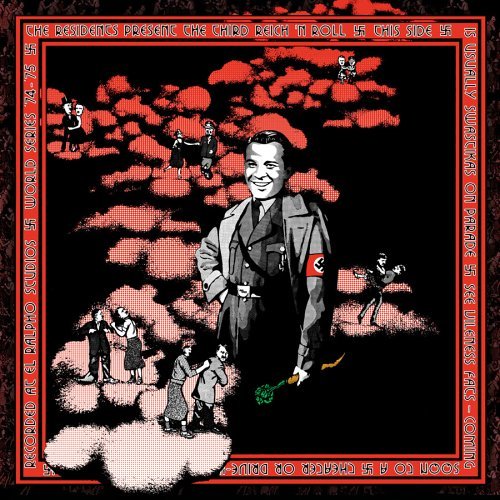
The group's second release Third Reich N' Roll has one of the most iconic covers of all time--a young-ish Dick Clark in Nazi regalia holding a carrot, while crossdressing mini-Hitlers traipse all over the fluffy pink clouds behind him. The whole concept is a bit of silly musical Godwin, comparing the staid oldies of corporate radio to fascism but fuck, with a cover like that you have to wonder what's in store for the buyer of said vinyl. And this doesn't disappoint. Made up of two side-long suites ("Swastikas On Parade" and "Hitler Was A Vegetarian"), The Residents assembled covers of '60s and early '70s pop standards and then took a giant shit on them in the best possible way.

After a brief sample of the German-translated "Let's Twist Again" the album flies off into some kind of maniacal proto-industrial/punk/Krautrock/WTF concoction, the source material violated by a kitchen sink of toy instruments, garbled and bizarre vocals, evil minor-key synths and random sound effects to the point where they are only somewhat recognizable. Ever wanted to hear "A Horse With No Name" as a funeral march? It's here. A German version of "Papa's Got A Brand New Bag" with dying-animal trumpet bleats? Yup. "Yummy Yummy Yummy" warped into some Middle Eastern raga? Check. Also one of the weirdest versions of FM sacred cow "Light My Fire" you will ever hear, and a truly sublime mash-up of "Hey Jude/Sympathy For The Devil" that is a great payoff after almost forty minutes of total headfuck. On some versions of the album there's even a gloriously abrasive take on "(Can't Get No) Satisfaction" that predates the '77 punk boom by a year or so.

Eskimo might be even weirder, and sounds like nothing else they ever did. Here they abandon Western music signposts (or anything else really) and record forty minutes of tribal chants, synthesizers and the occasional homemade wind instrument in a tongue-in-cheek attempt to capture what Inuit life must've been like.

And despite the group's inherent goofiness--they couldn't resist inserting buried references to Coca-Cola and other things--they mostly succeed. Eskimo has a truly unsettling, cold and alien ambiance that no other artist or band could come close to, a couple decades of black metal and electronica recorded since then notwithstanding. Tracks like "The Walrus Hunt" and "The Angry Angakok" with their hypnotic gibberish chants along with the creepy sound effects could really wig a listener out under certain, uh, "conditions." At times Eskimo achieves an eerie splendor reminiscent of the better Brian Eno or Steven Roach albums, and the outro of "The Festival of Death" even manages to be sort of pretty, kind of an anomaly when it comes to The Residents but a nice retort to anyone who thinks they're just being weird and anti-musical for its own sake. And it all ends the same way it began--with the sound of freezing Arctic winds. You'd probably have to look to anthropological field recordings to get something more authentic, and even then it probably wouldn't be as subtly engrossing as this album.

Through their fifty year long career few groups have defined arty iconoclasm better than The Residents have, and while their embrace of kitsch may strike some listeners as a novelty their broad creative horizons place them in the same growing realms as other champions of the American avant-garde. Whether it's from the inspired amateurism of early period or their later adventures in the live medium, they truly embody forward-thinking artistry in an era where many pose as the real deal and fall way short.

Translation:

If you want to hear oldies spoofed in some truly twisted and sick ways Third Reich N' Roll comes pretty highly recommended, obviously. Fans of Krautrock (some parts I swear sound exactly like Can) and early industrial would probably really enjoy this as well.

Eskimo
is a bit of a harder sell. Despite being highly regarded among Residents fans it's one of those "your mileage may vary" albums, especially if you haven't heard any of the more notable ambient artists (the aforementioned Eno and Roach, and others). Try some of that first and see if it grows on you before coming here.

-SJ